ETJava Beta | Java
 注册
登录
注册
登录
注册
登录
注册
登录
mybatis执行sql语句的操作是由执行器(Executor)完成的,mybatis中一共提供了3种Executor:
| 类型 | 名称 | 功能 |
|---|---|---|
REUSE |
重用执行器 | 缓存PreparedStatement,下一次执行相同的sql可重用 |
BATCH |
批量执行器 | 将修改操作记录在本地,等待程序触发或有下一次查询时才批量执行修改操作 |
SIMPLE |
简单执行器 | 对每一次执行都生成PreparedStatement,执行完就关闭,不缓存 |
另外,mybatis 还提供了一个缓存执行器CachingExecutor,该执行器实际上是以上三种执行器的装饰类,用以处理缓存相关操作,实际干活的还是以上三种执行器之一。
Executor的继续结构如下:
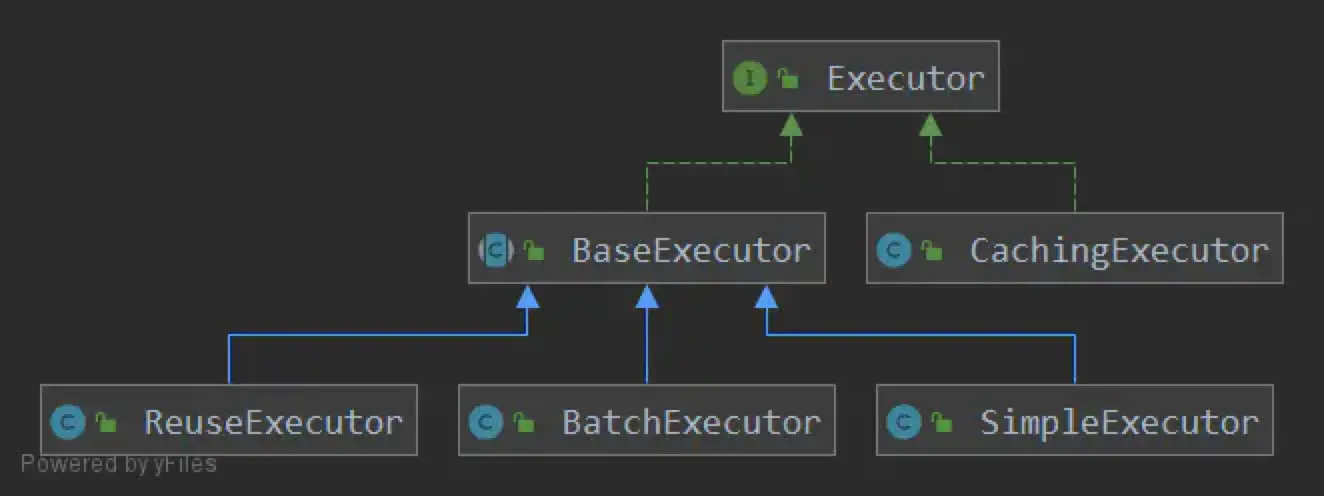
BaseExecutor实现了Executor的基本操作,如:
事务的处理:
commit(...):处理事务的提交rollback(...):处理事务的回滚缓存的处理:
createCacheKey(...):创建缓存keyclearLocalCache(...):清除缓存curd操作:
query(...):查询操作update(...):更新操作,插入与删除也是在这里处理留待子类的实现
doUpdate(...):具体的更新操作,留待子类实现doQuery(...):具体的查询操作,留待子类实现接下来我们关注Executor的实现时,只关注留待子类实现的方法。
SimpleExecutor会对每一次执行都生成PreparedStatement,执行完就关闭,不缓存,我们来看看它是怎么实现的,来看看它的doQuery(...)方法:
  public <E> List<E> doQuery(MappedStatement ms, Object parameter, RowBounds rowBounds,
		ResultHandler resultHandler, BoundSql boundSql) throws SQLException {
	Statement stmt = null;
	try {
	  // 获取配置
	  Configuration configuration = ms.getConfiguration();
	  StatementHandler handler = configuration.newStatementHandler(wrapper, ms, parameter,
			rowBounds, resultHandler, boundSql);
	  // 得到 PrepareStatement
	  stmt = prepareStatement(handler, ms.getStatementLog());
	  // 执行查询
	  return handler.query(stmt, resultHandler);
	} finally {
	  // 关闭 Statement
	  closeStatement(stmt);
	}
  }
获取Statement的方法为SimpleExecutor#prepareStatement:
  private Statement prepareStatement(StatementHandler handler, Log statementLog)
		throws SQLException {
	Statement stmt;
	// 获取数据库连接
	Connection connection = getConnection(statementLog);
	// 获取 Statement
	stmt = handler.prepare(connection, transaction.getTimeout());
	// 处理参数设置
	handler.parameterize(stmt);
	return stmt;
  }
这个方法先是获取了数据库连接,接着获取Statement,然后处理了参数设置。
关于数据库连接的获取,我们在分析配置文件的解析时,数据源的配置最终会转化成PooledDataSource或UnpooledDataSource对象,数据库连接就是从数据源来的。
至于Statement的生成,PreparedStatement的实例化操作方法为PreparedStatementHandler#instantiateStatement,这些都是常规的jdbc操作,就不细看了。
处理sql的执行方法为PreparedStatementHandler#query:
  @Override
  public <E> List<E> query(Statement statement, ResultHandler resultHandler) throws SQLException {
	PreparedStatement ps = (PreparedStatement) statement;
	// 执行
	ps.execute();
	return resultSetHandler.handleResultSets(ps);
  }
SimpleExecutor#doQuery(...)的执行流程如下:
PrepareStatementPrepareStatementSimpleExecutor的操作就是常规的jdbc操作。
ReuseExecutor会缓存PreparedStatement,下一次执行相同的sql可重用。
我们依然分析doQuery(...)方法:
  public <E> List<E> doQuery(MappedStatement ms, Object parameter, RowBounds rowBounds,
		ResultHandler resultHandler, BoundSql boundSql) throws SQLException {
	Configuration configuration = ms.getConfiguration();
	StatementHandler handler = configuration.newStatementHandler(wrapper, ms, parameter,
			rowBounds, resultHandler, boundSql);
	// 获取 Statement
	Statement stmt = prepareStatement(handler, ms.getStatementLog());
	// 处理查询操作
	return handler.query(stmt, resultHandler);
  }
与SimpleExecutor相比,ReuseExecutor的doQuery(...)方法并没关闭Statement.我们来看看Statement的获取操作:
private Statement prepareStatement(StatementHandler handler, Log statementLog)
		throws SQLException {
	Statement stmt;
	BoundSql boundSql = handler.getBoundSql();
	String sql = boundSql.getSql();
	// 根据sql语句判断是否有Statement缓存
	if (hasStatementFor(sql)) {
	  // 有缓存,直接使用
	  stmt = getStatement(sql);
	  applyTransactionTimeout(stmt);
	} else {
	  // 没缓存,获取数据库连接,再获取 Statement
	  Connection connection = getConnection(statementLog);
	  stmt = handler.prepare(connection, transaction.getTimeout());
	  // 缓存 Statement
	  putStatement(sql, stmt);
	}
	// 处理参数
	handler.parameterize(stmt);
	return stmt;
}
可以看到,ReuseExecutor获取Statement时,会先从缓存里获取,缓存里没有才会新建一个Statement,然后将新建的Statement添加到缓存中。从这里可以看出,ReuseExecutor的Reuse,复用的是Statement。
我们再来看看缓存Statement的结构:
public class ReuseExecutor extends BaseExecutor {
  private final Map<String, Statement> statementMap = new HashMap<>();
  ...
  private Statement getStatement(String s) {
	return statementMap.get(s);
  }
  private void putStatement(String sql, Statement stmt) {
	statementMap.put(sql, stmt);
  }
}
由些可见,缓存Statement的是一个Map,key为sql语句,value为Statement.
BatchExecutor会将修改操作记录在本地,等待程序触发或有下一次查询时才批量执行修改操作,即:
insert,update,delete)时,并不会立即执行,而是会缓存到本地select)时,会先处理缓存到本地的修改操作,再进行查询操作从以上内容来看,这种方式似乎有大坑,列举几点如下:
我们来看下BatchExecutor的更新操作,进入doUpdate(...)方法:
  public int doUpdate(MappedStatement ms, Object parameterObject) throws SQLException {
	final Configuration configuration = ms.getConfiguration();
	final StatementHandler handler = configuration.newStatementHandler(this, ms, parameterObject,
			RowBounds.DEFAULT, null, null);
	final BoundSql boundSql = handler.getBoundSql();
	final String sql = boundSql.getSql();
	final Statement stmt;
	// 如果传入的sql是当前保存的 sql,直接使用
	if (sql.equals(currentSql) && ms.equals(currentStatement)) {
	  int last = statementList.size() - 1;
	  stmt = statementList.get(last);
	  applyTransactionTimeout(stmt);
	  handler.parameterize(stmt);// fix Issues 322
	  BatchResult batchResult = batchResultList.get(last);
	  batchResult.addParameterObject(parameterObject);
	} else {
	  // 创建连接,获取 Statement
	  Connection connection = getConnection(ms.getStatementLog());
	  stmt = handler.prepare(connection, transaction.getTimeout());
	  handler.parameterize(stmt);    // fix Issues 322
	  currentSql = sql;
	  currentStatement = ms;
	  statementList.add(stmt);
	  batchResultList.add(new BatchResult(ms, sql, parameterObject));
	}
	// 保存,等待之后批量执行
	handler.batch(stmt);
	return BATCH_UPDATE_RETURN_VALUE;
  }
BatchExecutor有成员变量会记录上一次执行的sql与MappedStatement,如果本次执行的sql与MappedStatement与上一次执行的相同,则直接使用上一次的Statement,否则就新建连接、获取Statement.
得到Statement后,会调用PreparedStatementHandler#batch方法:
  public void batch(Statement statement) throws SQLException {
	PreparedStatement ps = (PreparedStatement) statement;
	ps.addBatch();
  }
这个方法并没有执行,只是调用PreparedStatement#addBatch方法,将当前statement保存了起来。
PreparedStatement#addBatch方法如何使用呢?简单示意下:
// 获取连接
Connection connection = getConnection();
// 预编译sql
String sql = "xxx";
PreparedStatement statement = connection.prepareStatement(sql);
//记录1
statement.setInt(1, 1);
statement.setString(2, "one");
statement.addBatch();
//记录2
statement.setInt(1, 2);
statement.setString(2, "two");
statement.addBatch();
//记录3
statement.setInt(1, 3);
statement.setString(2, "three");
statement.addBatch();
//批量执行
int[] counts = statement.executeBatch();
// 关闭statment,关闭连接
...
BatchExecutor的doUpdate(...)方法并没有执行sql语句,我们再来看看doQuery(...)方法:
  public <E> List<E> doQuery(MappedStatement ms, Object parameterObject, RowBounds rowBounds,
		ResultHandler resultHandler, BoundSql boundSql) throws SQLException {
	Statement stmt = null;
	try {
	  // 处理缓存中的 statements
	  flushStatements();
	  Configuration configuration = ms.getConfiguration();
	  StatementHandler handler = configuration.newStatementHandler(wrapper, ms, parameterObject,
			rowBounds, resultHandler, boundSql);
	  // 获取连接,获取Statement,处理参数
	  Connection connection = getConnection(ms.getStatementLog());
	  stmt = handler.prepare(connection, transaction.getTimeout());
	  handler.parameterize(stmt);
	  // 执行查询
	  return handler.query(stmt, resultHandler);
	} finally {
	  // 关闭 Statement
	  closeStatement(stmt);
	}
  }
doQuery(...)方法会先调用flushStatements()方法,然后再处理查询操作,整个过程基本同SimpleExecutor一致,即”获取数据库连接-获取Statement-处理查询-关闭Statement“等几步。我们重点来看flushStatements()方法的流程.
flushStatements()方法最终调用的是BatchExecutor#doFlushStatements方法,代码如下:
  public List<BatchResult> doFlushStatements(boolean isRollback) throws SQLException {
	try {
	  List<BatchResult> results = new ArrayList<>();
	  if (isRollback) {
		return Collections.emptyList();
	  }
	  // 遍历的statementList,statementList就是缓存statement的结构
	  for (int i = 0, n = statementList.size(); i < n; i++) {
		Statement stmt = statementList.get(i);
		applyTransactionTimeout(stmt);
		BatchResult batchResult = batchResultList.get(i);
		try {
		  // 关键代码:stmt.executeBatch(),批量执行sql
		  batchResult.setUpdateCounts(stmt.executeBatch());
		  ...
		} catch (BatchUpdateException e) {
		  ...
		}
		results.add(batchResult);
	  }
	  return results;
	} finally {
	  ...
	}
  }
BatchExecutor#doFlushStatements方法的关键代码就是batchResult.setUpdateCounts(stmt.executeBatch());了 ,其中的stmt.executeBatch()就是批量执行更新操作了。
从以上分析可知,BatchExecutor#doUpdate(...)方法不会执行sql语句,只是把sql语句转换为Statement然后缓存起来,在执行BatchExecutor#doQuery(...)方法时,会先执行缓存起来的Statement,然后再执行查询操作,当然也可以手动调用BatchExecutor#flushStatements方法执行缓存的Statement。
CachingExecutor不同于以上3种执行器,它是一个装饰类,可以从缓存中获取数据,实际干活的还是以上三种执行器之一:
public class CachingExecutor implements Executor {
  // 具体的执行器
  private final Executor delegate;
  private final TransactionalCacheManager tcm = new TransactionalCacheManager();
  public CachingExecutor(Executor delegate) {
	this.delegate = delegate;
	delegate.setExecutorWrapper(this);
  }
  ...
}
从代码来看,它是Executor的子类,其中有一个成员变量delegate,它的类型为Executor,由构造方法传入。也就是说,在创建CachingExecutor时,会传入以上3种执行器之一,CachingExecutor会把它保存到成员变量delegate中。
CachingExecutor的query(...)方法如下:
  public <E> List<E> query(MappedStatement ms, Object parameterObject, RowBounds rowBounds,
		ResultHandler resultHandler) throws SQLException {
	BoundSql boundSql = ms.getBoundSql(parameterObject);
	// 创建缓存key
	CacheKey key = createCacheKey(ms, parameterObject, rowBounds, boundSql);
	return query(ms, parameterObject, rowBounds, resultHandler, key, boundSql);
  }
  @Override
  public <E> List<E> query(MappedStatement ms, Object parameterObject, RowBounds rowBounds,
		ResultHandler resultHandler, CacheKey key, BoundSql boundSql)
	  throws SQLException {
	Cache cache = ms.getCache();
	// 操作缓存
	if (cache != null) {
	  flushCacheIfRequired(ms);
	  if (ms.isUseCache() && resultHandler ** null) {
		ensureNoOutParams(ms, boundSql);
		@SuppressWarnings("unchecked")
		// 从缓存中获取
		List<E> list = (List<E>) tcm.getObject(cache, key);
		if (list ** null) {
		  // 实际处理查询的操作
		  list = delegate.query(ms, parameterObject, rowBounds, resultHandler, key, boundSql);
		  // 添加到缓存中
		  tcm.putObject(cache, key, list); // issue #578 and #116
		}
		return list;
	  }
	}
	return delegate.query(ms, parameterObject, rowBounds, resultHandler, key, boundSql);
  }
从代码上来看,CachingExecutor在处理查询时,会先从缓存中获取,当缓存中不存在时,就执行具体执行器的query(xxx)方法。
 官方公众号
官方公众号